- About
- Programmes
- campus
- Admissions
- Careers & Placement
- Experience
- Contact
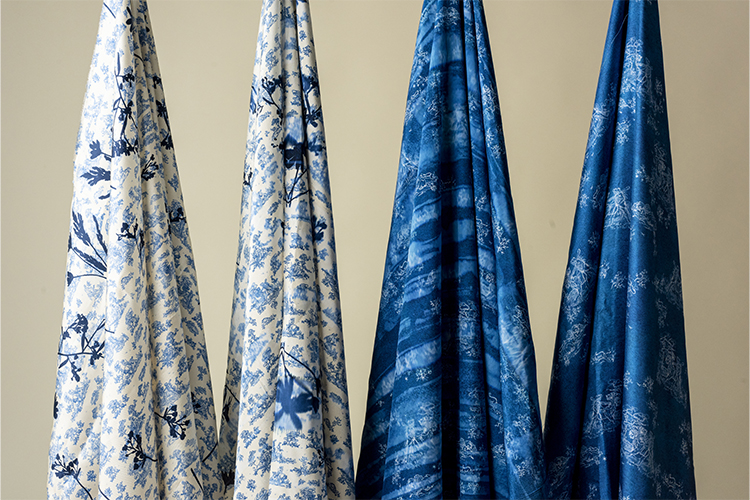
The Master in Fabrics Innovation Design of Accademia Costume & Moda it is an international programme delivered in Rome, created in collaboration with the Italian textile supply chain to train the next generation of material professionals for fashion and luxury.
With a 93% employment rate, the Master in Fabrics Innovation Design is a benchmark for those wishing to build a career in fashion, luxury, and material innovation.
We spoke with Marco Mastroianni, Head of Materials – LVMH and Scientific Director of the Master, who explains how textile culture remains a key element today for understanding the past and innovating with awareness.
From the laboratory to the LVMH Group.
In recent years, you’ve seen a major shift in the demand for professionals specialising in materials and textiles. Today, what kind of profiles are luxury and fashion companies really looking for?
Over the past fifteen years, the fashion world has changed completely. The new generation of designers has a very different approach to work compared to what I was used to. Today, companies are looking for professionals capable of carrying out research, but also of providing quick, effective and high-quality solutions. They want everything, immediately – but with culture and vision. Speed has become a key skill: there’s no time to waste, and no mercy for anyone.
From my point of view, however, the true value still lies in culture – especially textile and fashion culture. Designers often come in with vintage garments as references: to reinterpret them, you need to know which historical period they belong to, what materials were used, which colours were popular, and how to translate all of that into a contemporary language. Reinterpreting the past and making it relevant today is the real challenge.
What I look for – and what I believe the industry increasingly seeks – is therefore a combination of cultural depth, technical knowledge and speed of execution. And that’s also why the Master in Fabrics Innovation Design is so important: textile history is the key to understanding the past and projecting it into the future, with awareness and innovation.
A forward-looking education
How does the Master in Fabrics Innovation Design at ACM respond to the real and current needs of the industry? What makes it, in your view, such a unique and necessary programme today?
What truly makes the Master in Fabrics Innovation Design special and essential is its journey through the history of textiles. It’s a voyage through time, allowing students to understand the techniques, patterns and aesthetics of each era. From the refinement of Renaissance motifs to the experimental printed warp “chiné” of the 1950s, every period reveals a different way of conceiving fabric — and knowing these roots is essential for innovating consciously.
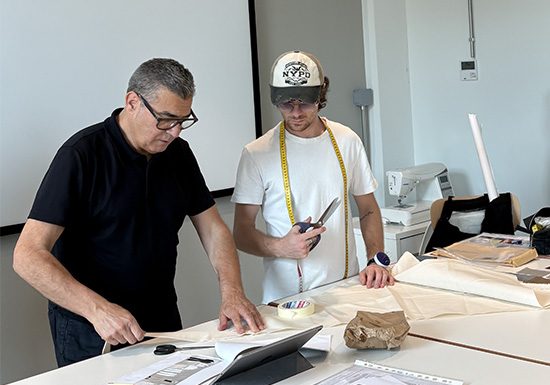
At the same time, the Master offers direct contact with the industrial world. The projects students develop with suppliers and designers are structured exactly as they are in the professional world: there’s an initial briefing, the need to interpret a creative vision, and the challenge of translating it into a tangible material. This experience prepares them to work effectively in the sector, exposing them to real dynamics between creativity, technique and production timelines.
In this sense, the Master is a comprehensive and realistic training ground — combining culture, technical skill and design methodology: three essential elements for entering today’s world of fashion and luxury.
The textile world is changing fast: what new professional roles are emerging in the field of fashion and luxury materials? And what skills are truly needed to build a solid career in this field?
The textile world is undergoing profound change because we are gradually losing our textile culture. Economic crises, mechanisation, industrialisation and the impact of fast fashion have challenged many artisanal companies that were once the jewels of our know-how. Many of these businesses, custodians of extraordinary expertise, are sadly disappearing.
For those of us who have at least partly known that world, it’s still possible to reconstruct and reinterpret ancient techniques, making them relevant again. I’m thinking, for example, of velour au Sabre, now produced by only one manufacturer in Lyon, or the challenge of reproducing a nineteenth-century fabric on a twenty-first-century loom. The true evolution of the sector lies in this tension between past and future.
In recent years, awareness has also changed: after pushing too hard on the accelerator, we’ve realised the environmental impact of fast fashion, and sustainability has become a central issue. However, we must not forget that fashion is born from creativity. Artistic directors seek people capable of working experimentally, as in a true creative laboratory, not only within industrial frameworks. I deeply believe in this balance: on one hand, the concreteness of the market and industry; on the other, the freedom and imagination of the studio. That’s what I try to convey to my students — to remain 100% creative, yet able to bring that creativity into the production world. Because, in the end, our greatest satisfaction comes from seeing people wear our fabrics and knowing that behind them there’s culture, research and passion.
Advice for those choosing their future
What would you say to a young person unsure about enrolling? What career opportunities does a programme like this truly open up in the world of fashion and luxury?
No academic qualification truly limits the opportunities of those who want to enter the fashion world. I’ve seen people from completely different backgrounds become successful designers: passion, curiosity and the ability to learn are far more important than a formal educational path.
The Master in Fabrics Innovation Design, in addition to providing technical expertise, offers a humanistic and cultural education encompassing history, art, fashion and textiles. This opens up a range of professional paths: some may pursue a career in textile research — like some of my assistants, who work on both womenswear and menswear collections — while others become graphic designers collaborating with suppliers on textile print development. One can also become a fashion designer or costume designer, enriching one’s material knowledge and learning how to interpret and create fabrics consciously.
Understanding fabric means knowing how it behaves on a volume, how to communicate it to the person conducting the research for you, and how to turn an idea into a tangible reality. In this sense, textile culture combined with creativity is a fundamental passport for working in fashion and luxury, regardless of one’s formal background.
Innovation as an attitude
What does “innovation” mean to you when it comes to materials? Is it more a matter of technology, sensitivity, or creative vision?
For me, innovation means making full use of knowledge and creativity. Technical knowledge, acquired over the years, is the foundation upon which creativity can flourish. Those starting out now still need to build that foundation — but the more you know, the more you can play with time, technique and creative potential.
Often, however, modern technology doesn’t support creativity as it should. We’re capable of extraordinary things, yet we’ve allowed historic textile techniques to die out, and today we can no longer bring them back to life: the desire is gone, because they don’t generate immediate business. When I leaf through nineteenth-century textile books and see jacquard velvets with English grounds, I wonder why technology can achieve so much, yet can’t help me reproduce that work of art.
At the same time, there are extraordinary modern techniques — such as 3D printing, transfer printing and other innovations — that allow us to enrich traditional materials with new languages. That’s why I enjoy experimenting with these innovative techniques on historical fabrics: applying 3D printing to an antique jacquard, for example, merges past and present, technique and creativity.
Ultimately, innovation is a balance between culture, technical knowledge and creativity: the more you know, the more you can free your imagination and transform it into unique materials capable of telling stories that transcend time. Some designers are now reviving traditional techniques such as jacquard weaving, combining them with modern technologies. For instance, the Textile Prototyping Lab project at the Weißensee Academy of Art promotes collaboration between textile designers and engineers to develop smart fabrics. Then there’s all the innovation driven by sustainability: young designers are embracing bio-based and recycled materials such as Tencel, Seacell and fibres derived from algae or fungi. These materials are becoming standard in the industry, with brands like Stella McCartney and Adidas using them to combine environmental responsibility with fashionable design.
From the classroom to the industry
How does a student’s perspective change once they begin working with companies and professionals in the field? Is there a moment that, in your view, marks a real turning point in their journey?
The transition from school to work is always a major transformation. In the classroom, students learn techniques, textile history, culture and creativity — but it’s only when they face the real world that they truly understand what it means to apply all of that. The turning point, I think, comes when they meet someone like me — ahahah — a mentor or professional who guides them, challenges them and tests them as in the real job world. That’s when they learn to handle briefings, tight deadlines and the concrete demands of designers or clients, developing problem-solving and decision-making skills.
They also discover that 30–40% of the job is about human relationships: communication, collaboration, people management, building trust and solid connections. Work teaches you to build relationships, to engage with different perspectives and to coordinate the energies of those around you.
It’s a stage of immense growth: what was once just theory, study or exercise becomes real competence, hands-on experience and confidence in one’s work. In the end, this human element — together with creativity and technique — is what truly enables someone to become a professional capable of contributing meaningfully to the world of fashion and luxury.


Become a driving force in textile innovation for the fashion and luxury industries.
The Master in Fabrics Innovation Design at Accademia Costume & Moda offers a unique programme in Rome, developed in collaboration with the Italian textile supply chain. It combines industry projects, professional workshops and international opportunities in a fully immersive learning experience that blends textile culture, technical research and creative design within a teaching framework built alongside leading companies in the field.
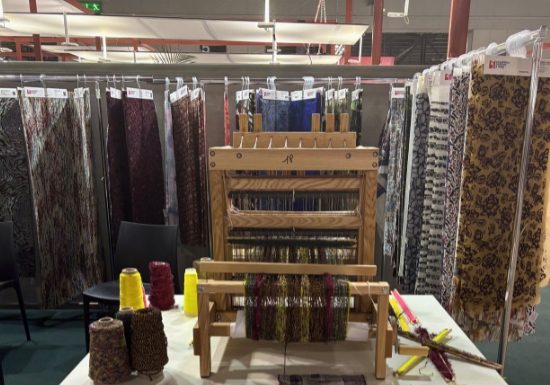
Throughout the year, students develop Industry Projects in collaboration with brands and textile manufacturers, take part in workshops with industry professionals, and have the chance to present their fabrics at Milano Unica — Italy’s most important trade fair with an international scope dedicated to fashion and textile professionals.
Find out more and apply now.