- About
- Programmes
- campus
- Admissions
- Careers & Placement
- Experience
- Contact
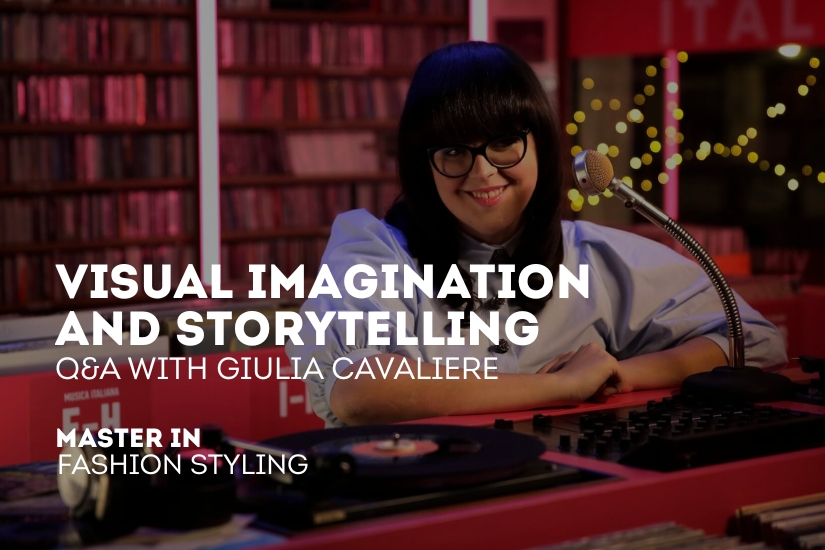
Giulia Cavaliere is a journalist, cultural critic and author. She has contributed to publications including Corriere della Sera, Rolling Stone Italia and Esquire, and is the author of the book Romantic Italia, which later became both a successful podcast and a television programme on Sky Arte.
She also teaches courses in music writing and narrative, bringing to her relationship with students an analytical, sensitive and deeply literary perspective.
Through both her teaching and professional practice, Giulia explores image, rhythm, meaning and the impact of the stories we tell — whether through songs, texts, sounds or visual languages. This is precisely why her voice represents such an important contribution for those training within the worlds of fashion and visual communication: knowing how to read and interpret aesthetic codes is just as essential as knowing how to create them.
We asked Giulia to share her thoughts on how imagery and storytelling intersect with the aesthetic narrative that lies at the heart of our Master in Fashion Styling.
Q1. Your work demonstrates how language comes before image. For those studying Fashion Styling, how essential is it to build linguistic and cultural awareness — spanning music, literature and the performing arts — before even thinking about aesthetics?
I strongly believe in the importance of offering students a broader depth of field — in other words, a solid cultural context that can become the framework within which they operate consciously and make their own specific professional choices.
I believe it is essential for anyone who may one day work daily within the world of fashion styling to understand the grammar of performance language, its multiplicity and heterogeneity, and the possibilities this diversity offers. Only in this way can they make precise choices, take informed decisions regarding the specifics of the sector in which they will work every day, and ultimately be able to defend those choices and decisions.
Q2. In Romantic Italia, you analyse songs as narrative devices that shape the collective imagination. If fashion does not originate from fashion itself, but from an intersection of cultural references, what kind of education in listening and reading the world should a stylist develop?
A stylist should understand the hybridisation of languages and recognise that no music, art form, literature, cinema or cultural expression exists in isolation from the others. The collective imagination is made up of distinct yet deeply interconnected elements: worlds communicate with one another, they blend together, and contemporaneity asks us to listen with our eyes and observe with our ears fully alert.
There are no boundaries, and this is extraordinary because it opens up an infinite range of possibilities for those working within culture — a space that fashion must also inhabit. Entering the fashion industry without a strong cultural education simply means not having access to the essential material needed to work.
Q3. A stylist works with images, but ultimately constructs narratives. How important is it to master narrative tools — rhythm, tone, context and citation — in order to transform a look into a recognisable cultural statement?
More than ever in recent years, fashion has shown a compulsive desire to collect, reference and return to its audience a rich and often unpredictable assortment of stories and worlds — elements drawn both from pop culture and from the history of counterculture and political movements.
One example is Alessandro Michele referencing F.U.O.R.I. — the Italian Revolutionary Homosexual United Front — across several garments during the Milan Fashion Week Gucci Spring/Summer 2023 show.
In that moment, the political history of this country became an extraordinarily powerful narrative tool. For stylists, it offered vibrant material to work with — a space for discovery to bring into the world, to explore more deeply rather than simply reference superficially.
Q4. We live immersed in a constant flow of content. How can one train a critical eye capable of distinguishing between simple aesthetics and the construction of meaning — between surface and language?
This question has an impossible answer because it is pure, while our world is anything but pure. However, you used a key word: training. Daily study, constant engagement with content and investigating what lies beneath it help reveal what is substantial and what is merely being used superficially for profit.
The same gesture — whether in styling or painting a canvas — can hold deep and radical meaning, or simply exist on a superficial, performative level. Fashion, however, like painting and every expressive form, has the ability to construct not only sentences but entire discourses. In doing so, it can give solidity to its vision and perspective, making it no longer suspended, but potentially deeply rooted and enduring.
Q5. For those approaching a path such as the Master in Fashion Styling, how important is it to cultivate a broad cultural education — from music to writing, cinema to criticism — in order to become professionals capable of generating imaginaries rather than simply following them?
Listening, reading and writing in order to give full and complete form to one’s imagination and creative vision are essential elements for any profession involving creativity. Creativity cannot exist without continuously nourishing our gaze, our listening and the experiences we encounter daily through an infinite multitude of languages. A lack of curiosity, study and deeper exploration — failing to constantly feed one’s imagination through all the imaginaries that have crossed the history of the world — drastically limits both expressive possibilities and passion for what one does.
Within the Master in Fashion Styling at Accademia Costume & Moda future professionals learn not only how to master technical tools, but also how to navigate languages, contexts and narratives: from creating moodboards and editorial projects to developing an aesthetic vision capable of engaging with global visual culture. Alongside figures such as Giulia — who approaches pop culture and its codes with critical rigour — students refine their ability to interpret and narrate forms, meanings and stories with awareness and depth.