- About
- Programmes
- campus
- Admissions
- Careers & Placement
- Experience
- Contact
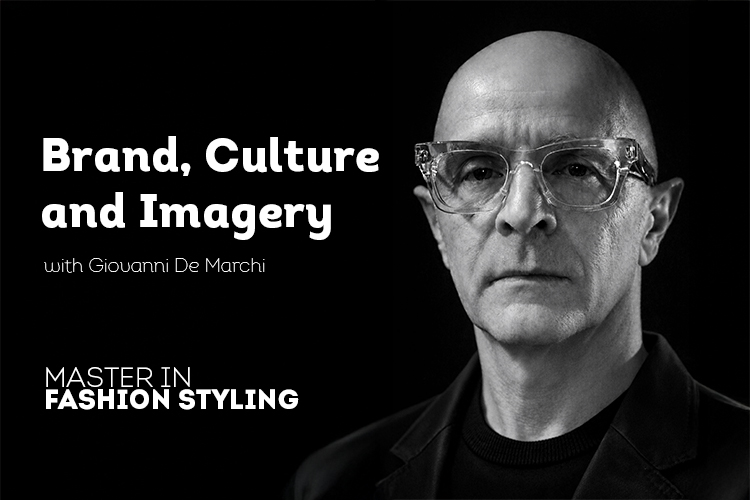
Giovanni De Marchi is an international professional specialising in Brand, Marketing & Culture Consulting within the Fashion, Sportswear and Lifestyle sectors. He has held leadership roles such as Managing Director at A-COLD-WALL*and Chief Marketing Officer at Tomorrow London, as well as working on communication and positioning strategies for global brands. His career combines cultural vision, brand strategy and creativity — essential skills for anyone wishing to operate in fashion today with a broad and contemporary outlook.
Throughout his career, he has worked in strategic roles within the marketing departments of companies such as Slam Jamand Tomorrow, leading collaboration projects between iconic brands that resulted in collections blending fashion, streetwear and urban culture.
We asked Giovanni to explain how strategic brand thinking intersects with the aesthetic and narrative vision at the heart of our Master in Fashion Styling.
Q1. Your work weaves together brand strategy, marketing and visual culture. Styling is often perceived as purely aesthetic, yet fashion does not originate from fashion alone: it emerges from languages, arts, music, performance and cultural systems. How fundamental is it for a young stylist to understand these codes and integrate them into a strategic brand vision?
Today it is fundamental. It is one of the core points of the module I teach within the Master’s programme.
On one hand, the work with students is deliberately very practical: understanding how a brand is created, how it reaches the market, who is behind it, how teams are structured, who actually works on building a brand and, above all, how a brand becomes economically sustainable over time. Creativity in fashion does not exist outside the system that makes it possible.
But there is also a second level, equally important. I try to make students understand that they themselves are a brand. They must ask what change they want to create in the world through their work, who they want to speak to, what vision they want to bring forward and what distinguishes them.
Styling today is not merely aesthetic construction. It is the construction of meaning. And meaning always arises from a cultural context: music, cinema, art, sport, subcultures, cities, communities. Without this awareness, the risk is producing images that are correct but devoid of depth.
Q2.Today brands construct identities through complex imaginaries that draw equally from artistic and performative culture as well as from branding and positioning. How can styling become a bridge between poetic input and a more technical dimension, contributing to the definition of a strong and contemporary visual identity?
Styling is the point where poetic vision meets the concrete structure of the brand.
On one side there are cultural intuitions, aesthetic sensitivities, storytelling and imaginaries. On the other, there are tangible constraints: target audience, pricing, distribution, commercial calendar, collection coherence and brand consistency.
A contemporary stylist must be able to transform inspiration into a structured visual language. Not merely build looks, but construct an aesthetic grammar that is recognisable over time.
It is no coincidence that today, in many contexts, the stylist holds a relevance comparable to that of the designer — and in some cases even greater — in shaping a brand’s aesthetic language. The stylist operates precisely at the intersection where product, image, culture and public perception meet.
When styling truly works, it makes positioning tangible. It enables the product to speak the right language to the right community, maintaining cultural depth alongside narrative and commercial clarity.
Q3. Collaborative projects between brands — such as A-COLD-WALL* with Arsenal Football Club or Martine Rose with Nike — demonstrate how sport, culture and fashion can merge into a single visual and cultural language. What can a stylist learn by observing these ecosystems, where cultural identity, product and storytelling are built together?
These projects teach us that today styling is never just styling. It is the construction of identity.
When fashion and sport engage in authentic dialogue, it is not merely about product. It is about belonging, territory, community and collective memory.
In projects that unite fashion and sporting institutions, the aim is not simply to reinterpret a sporting aesthetic, but to translate heritage and culture into a contemporary language — often more conceptual and aligned with current cultural expressions.
Similarly, the work of designers such as Martine Rose with Nike demonstrates how sport can be narrated as a cultural phenomenon even before it is considered performance. The most compelling collaborations explore identity, subcultures, new communities and new ways of experiencing and representing sport.
For a stylist, the lesson is clear: one must learn to read complete cultural systems — not only the product, but the people, the codes, the history and the social context.
The most powerful images emerge when aesthetics and strategy are aligned, and when there is genuine cultural truth behind what is being communicated.
Q4. Training a stylist today means shaping someone capable of reading the world: art, cinema, music, subcultures, but also market dynamics and branding. Which cultural and analytical skills do you consider indispensable in building this type of professional profile?
The most important skill is curiosity.
And immediately after that, the ability to feel genuinely enthusiastic about what one encounters.
A stylist works on the connections between different worlds. But these connections are not built solely through study; they are built through living, observing, listening, engaging with people, cultural languages and creative energies.
Art, cinema, music, subcultures, branding and the market all require openness of mind and emotional sensitivity, as well as analytical capacity.
In the long term, the real difference is made by those who manage to maintain a curious and lively gaze upon the world. Because styling is, above all, a way of seeing.
Q5. For those wishing to enrol in the Master’s in Fashion Styling: how important is it to develop a cross-disciplinary curiosity — spanning visual arts, performance, literature and strategic communication — in order to build a solid career in the fashion system?
It is central. As I mentioned earlier, curiosity is the foundation of everything. But the most practical advice I always give is this:
Live the cities.
Go to concerts.
Go to the cinema.
Visit exhibitions.
Observe people.
Walk through neighbourhoods.
Go into shops.
Speak with those who work in music, sport, creativity, nightlife and culture.
Culture does not exist only in books or online. It lives in cities, in communities, in real movements.
A stylist develops their perspective by living in the world with active curiosity — even simply by engaging with urban life through attentive eyes.
Fashion changes because culture changes.
And culture is lived before it is studied.
In the Master’s in Fashion Styling at Accademia Costume & Moda, the aim is not merely to learn how to construct looks or mood boards; students learn to read, interpret and visually narrate cultures, stories and contexts — skills that engage with the strategic vision of branding and communication.
Professionals such as Giovanni, who operate at the intersection of culture, image and strategy, help students think not only about what is created, but also how and why it is communicated — an essential key within the contemporary fashion system.